The Chilli Line-Up That Made The Year.
Top Ten Chillies of 2025
Every year a few chillies stand out — some for their flavour, some for their looks, and some simply because they made me smile whenever I passed them.
This time it was everything from the theatrical Thunder Cacho to the tiny perfection of Pimenta Caixo, with plenty of surprises in between. Not the “useful” ones necessarily, just the ones that brought the most pleasure.
Growing chillies has its own rhythm: checking the greenhouse in the morning, finding a new flush just when you think the season’s over, and realising you’ve fallen for plants you never expected to love. Here are the ones that made the year brighter.











10. Facing Heaven Tenth place for the quiet classic that pointed itself skyward and simply got on with things.
Some chillies carry themselves like old diplomats — calm, dignified, and entirely aware that whole cuisines have been leaning on them for centuries. Facing Heaven is one of those: a chilli with seniority. This is the classic Chinese skyward-pointing chilli, named for its habit of growing upright rather than drooping.
Originating in Sichuan and Chongqing, it’s a cornerstone of regional cooking: the backbone of gong bao (Kung Pao), the warmth in mapo tofu, the fruitiness in hot-oil dips and red-cooked stews, and the essential partner to Sichuan pepper in countless stir-fries. Facing Heaven seasons the oil, releasing fragrance first, heat second, depth throughout.
I let mine dry on the plant, as growers in Guizhou and Sichuan often do, and the result was perfect: each pod shrivelling into a deep, lustrous mahogany red. Drying this way intensifies the fruitiness and shifts the heat into that warm, measured profile. It becomes a pantry ingredient rather than a dare.
The plant itself was well-behaved — compact, productive, unpretentious. No sprawling baccatum theatrics, no chinense volatility. Just a steady stream of upward-facing pods, ripening neatly and storing beautifully. A jarful looks like something from a proper Chinese larder: practical, aromatic, quietly indispensable.
As winter draws in, I’m looking forward to using them in mapo tofu, Sichuan hot oil, slow braises, and the simple joy of tossing a few into a wok to perfume the oil. A world classic — a chilli that doesn’t shout for attention but earns it through sheer usefulness.

9. Turkish Snake Chilli Ninth - For sheer spectacle: long, dramatic, & delightfully unhinged.
Some chillies make an entrance; the Turkish Snake makes a descent — long, looping pods draped over the plant like silk ribbons, as if the whole thing were trying to slither off the table when your back was turned. Turkey has a deep affection for these elongated chillies, known broadly as yılan biberi (“snake pepper”) or çarliston/çarli depending on the region.
They’re everyday cooking chillies — piled high in markets from Izmir to Gaziantep, bought by the kilo for frying, stuffing, grilling over charcoal, or throwing whole into stews. Mild enough to use generously, flavourful enough to matter.
Mine grew exactly as their Anatolian reputation suggests: vigorous, sprawling, and hopelessly dramatic, flinging out pods that challenged even Thunder Mountain for length. They’re wonderfully unfussy plants — much like the biber dolmalık and biber sivri types, they’re perfectly content outdoors in a warm UK summer, fruit fast, and don’t sulk when the nights cool.
Fresh, the pods are crisp, mild, and grassy, ideal for a quick stir-fry where they soften and sweeten rather than scorch. In Turkey, they’re often blistered in olive oil and served with yoghurt, or sliced into menemen, the tomato–pepper–egg breakfast dish. Their mildness is intentional: these are chillies meant to be eaten in handfuls, not counted out like ammunition.
They also dry beautifully, curling into elegant spirals that deepen in colour and flavour. I’ve set aside a few for winter — destined to become a gentle, smoky note in stews, the culinary equivalent of a warm scarf.

8. Sivri Aci Biber Eighth goes to the endlessly agreeable one, always ready with another flush.
Some chillies earn their reputation by sheer force; Sivri Acı Biber earns it by turning up everywhere — on grills, in sauces, tucked into bread, scattered over breakfasts — the quiet backbone of Turkish heat. In Turkey, sivri biber is a category as much as a variety: long, slim, tapering chillies that anchor everyday cooking.
The acı versions — the hot ones — are what give life to the famed Sivri Acı Biber sosu, a sauce so simple and so devastatingly good that entire meals orient themselves around it. Fresh chillies pounded with tomato, garlic, lemon, and olive oil until it becomes a kind of hot Anatolian gazpacho; spoon it over grilled lamb, roasted chicken, köfte. Quite honestly, one of the world’s great condiments.
My plants behaved exactly as Turkish growers say they will: easy, reliable, and absurdly persistent. I started mine late, yet they still produced curtains of vivid green pods that hung off the plant like tassels. Even now — in December — the thing is still in the greenhouse, trying to pretend winter is a rumour. The plants are small, tidy, and astonishingly productive for their size.
Culinarily, this chilli is a gift. Young and green, it brings a clean heat to menemen, lahmacun, stir-fries, even a plate of chips. Left to ripen, the pods sweeten and deepen, becoming the perfect base for that tomato-rich Sivri Acı Biber sauce that tastes like summer stored in a jar. What I love most is how unpretentious it is. No theatrics, no super-hot swagger — just a chilli that earns its place on the table daily. If Turkish cuisine has a heartbeat, it might well be this.

7. Thunder Cacho Seventh - Because nothing else grew this long or looked this dramatic.
Thunder Cacho arrived entirely by accident — a mystery seedling whose label dissolved in the rain, leaving me to speculate wildly until it revealed itself like some lanky mountain spirit stepping out of the mist. What finally emerged were elegant, improbably long pods that hung from the plant like decorative tassels.
Their colour shift was even better: starting green, then sliding into a deep volcanic brown, the kind of pigmentation you often see in Andean and Mexican highland chillies where cool nights push plants to develop richer anthocyanins. Thunder Cacho is believed to be a mix of two mountain types, and it behaves like one — steady, resilient, unfussy, and shaped by altitudes where heat isn’t everything but complexity is.
The flavour echoes that heritage. Not super-hot — more a thoughtful warmth — but with a depth. These are the pods you throw into winter stews or long-simmering pots, not for fireworks but for structure.
They promise that quiet, earthy backbone you get from traditional Mexican chillies like Pasilla or Mulato, though with a slightly sharper top note. I dried a few to test their future — whole, they should perfume broths beautifully; ground, I can see them forming the base of a very decent rub.
What I like most is the serendipity of it all. I thought I was growing one thing, the greenhouse thought otherwise, and somewhere between us this long, bronzed creature turned up and behaved far better than the variety I’d intended. A gentle chilli, a handsome one, and very possibly a new favourite for the colder months.

6. Oro de Ecuador Sixth - Golden swagger from start to finish. Impossible not to enjoy.
Oro de Ecuador had the swagger of something fully aware of its own beauty — great golden orbs dangling from a tangle of foliage, like a fruit tree that had wandered into the wrong family and decided to stay. This is a true baccatum, and baccatums never pretend otherwise. They sprawl, they climb, they colonise the nearest structure.
Oro de Ecuador follows the script with enthusiasm: long, flexible branches, huge light-catching leaves, and pods almost too large and too golden to be real. In Ecuador it’s considered a kind of “golden child,” grown not just for flavour but for its sheer ornamental flair — as much display as crop.
The flavour is unmistakably baccatum: fruity, bright, lightly floral, with a clean, citrus-tinted heat. Thanks to ester-rich chemistry, it behaves more like a small golden pepper than a conventional chilli, which is why it’s often stuffed with cheese or soft meats in Ecuador. The shape makes practical sense; the heat level makes it welcoming.
Mine didn’t all reach those generous Ecuadorian sizes, so several ended up in a sweet brine where they shine even more. Pickled, they take on a bright clarity that works absurdly well with pizza, cheese boards, tacos — anything that needs colour and a lift. It’s the chilli most likely to make guests ask what on earth it is.
What I admire most is its good-natured chaos. A plant that sprawls everywhere, makes the greenhouse look festive, and produces fruit that feel celebratory even before you eat them. A charmer, through and through.
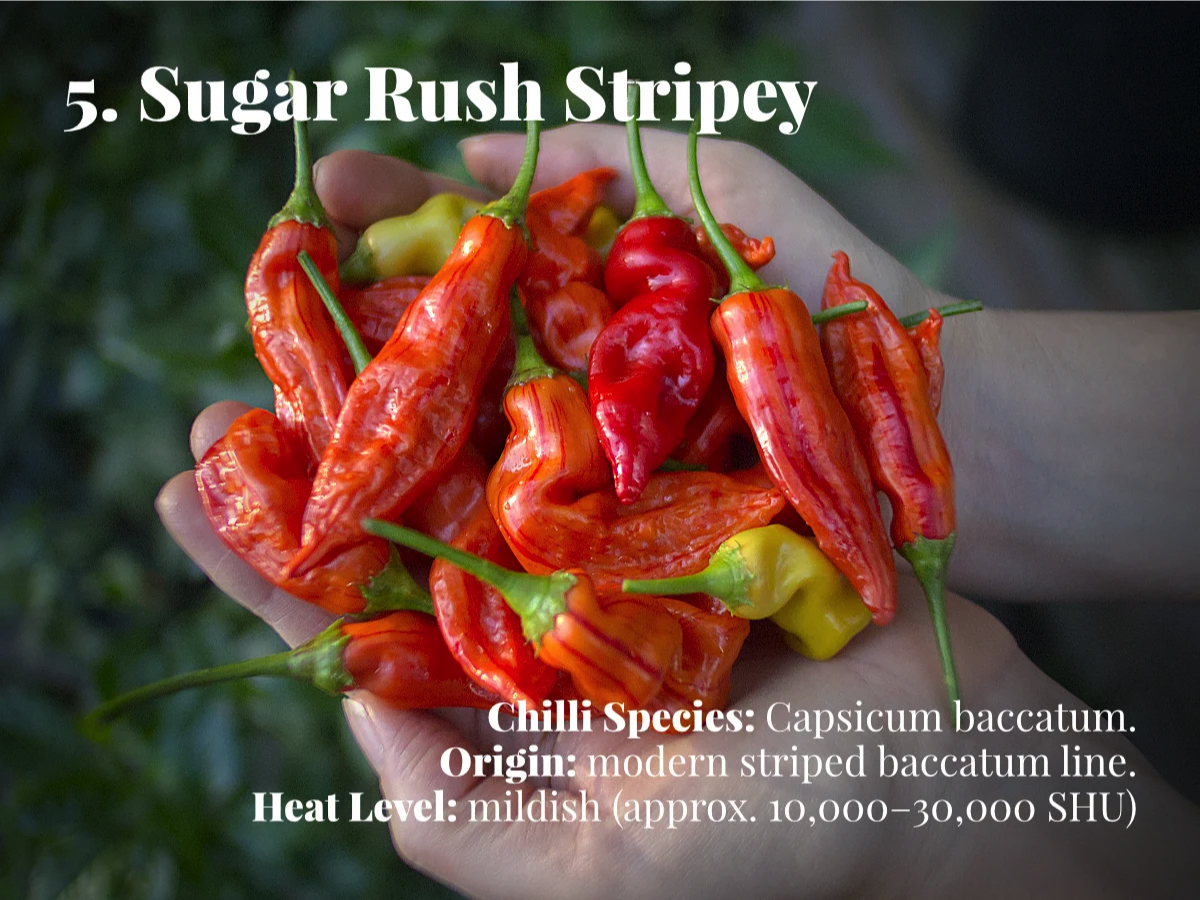
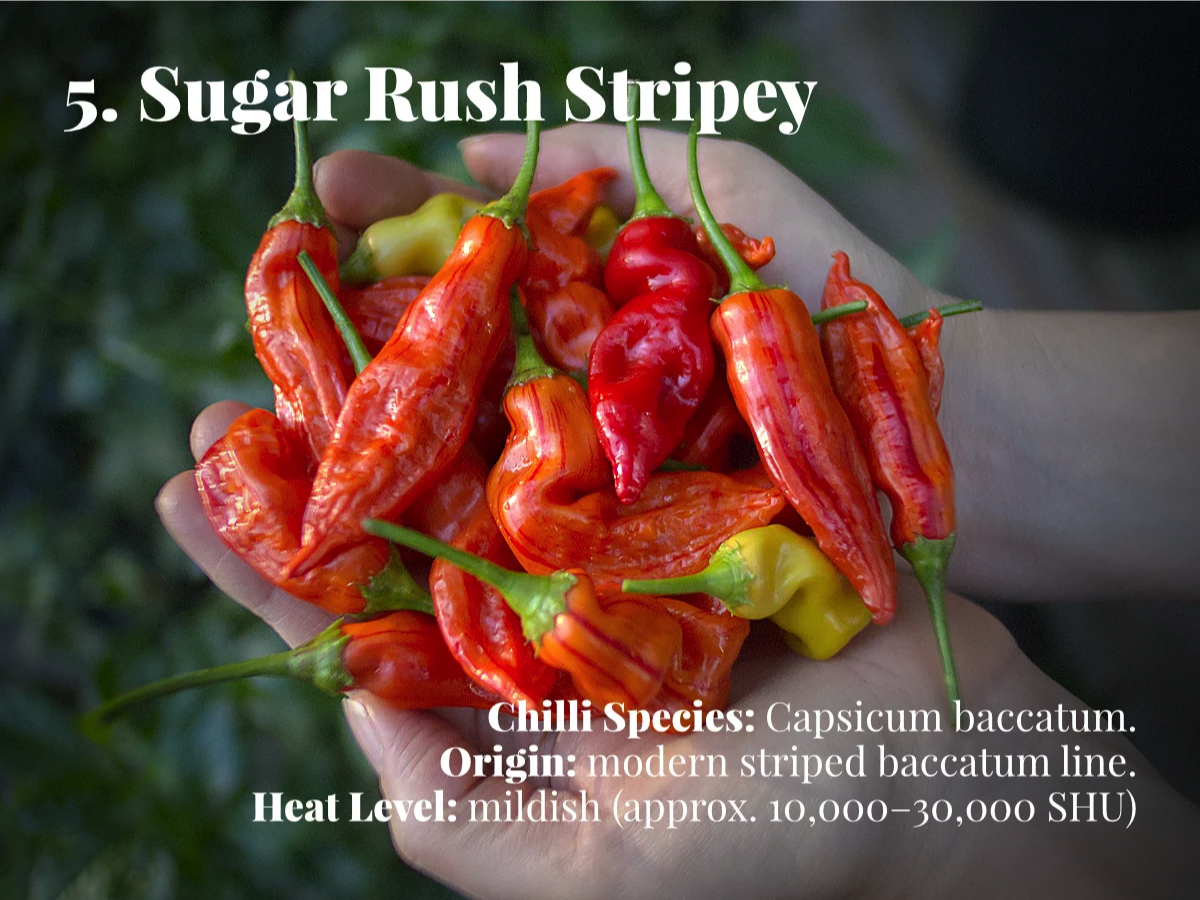
5. Sugar Rush StripeyFifth — the one that turned my greenhouse into a Victorian sweet shop.
Some chillies look as though nature got distracted mid-paint job; Sugar Rush Stripey looks as though it was finished by a Victorian confectioner with a steady hand and questionable restraint.
This variety is part of the modern “stripe” phenomenon — a trait discovered only in the last decade, caused by a rare interaction of anthocyanin expression and viral-patterning genes that, unusually, produces stable, inheritable striping rather than damage. The result is astonishing: each pod develops its own pattern of pinks, peaches, creams and coral, no two alike.
Being a baccatum, it behaves exactly as its ancestry dictates: dramatic, unruly, determined to annex the greenhouse by mid-August. Long flexible branches, big light-catching leaves, and a general sense that it would climb the rafters if given half a chance. But the show is worth it — when the pods ripen, the plant becomes a small festival of pastel fireworks. The flavour matches the theatre.
Sugar Rush types are known for their fruit-forward sweetness, and this variant keeps that clarity while adding a crispness from its thin skin. Heat is moderate, enough to give punctuation rather than punishment. I picked several with Christmas in mind, hoping their crunch and colour would hold in a gentle brine — if they do, they’ll be the prettiest things on the table.
What I love is how joyful this chilli is. It isn’t aiming for brutality or competition glory; it wants to be beautiful, useful, and slightly outrageous. A plant with no interest in tidiness, but every interest in delight.

4. Chocolate PrimoFourth for being brooding, potent, and oddly charming.
The Chocolate Primo never looked entirely trustworthy — the sort of chilli that sits quietly in the corner of the greenhouse like a dark-coated stranger in a Western, polite enough, but with a reputation that makes everyone keep one eye on the exits.
This variety comes from Louisiana grower Troy Primo, whose 7 Pot Primo is one of the fiercest chillies ever stabilised; the chocolate strain takes that ferocity and wraps it in deep brown pods packed with aromatic oils. “Chocolate” in chillies refers to the anthocyanin-rich pigmentation that develops under strong light — but the Chocolate Primo actually does offer a faint cacao-like earthiness beneath the heat, a rare case where the colour tells a kind of truth.
In the greenhouse it was surprisingly civilised: easy to manage, branching neatly, and never trying to annex the neighbouring tomatoes. Production was steady rather than frantic — and with super-hots, a few pods go a very long way. The pods themselves were beautiful: crumpled, leathery skins in dark mahogany.
I used mine in a warm chilli jam for toast, which sounds reckless but works beautifully. The Primo’s heat is assertive but clean, and the earthy undertones settle into sweetness in a way that feels oddly luxurious — a breakfast condiment with a secret life. For all its reputation, the Chocolate Primo proved surprisingly poised: intense, aromatic, and more versatile than its outlaw exterior suggests.

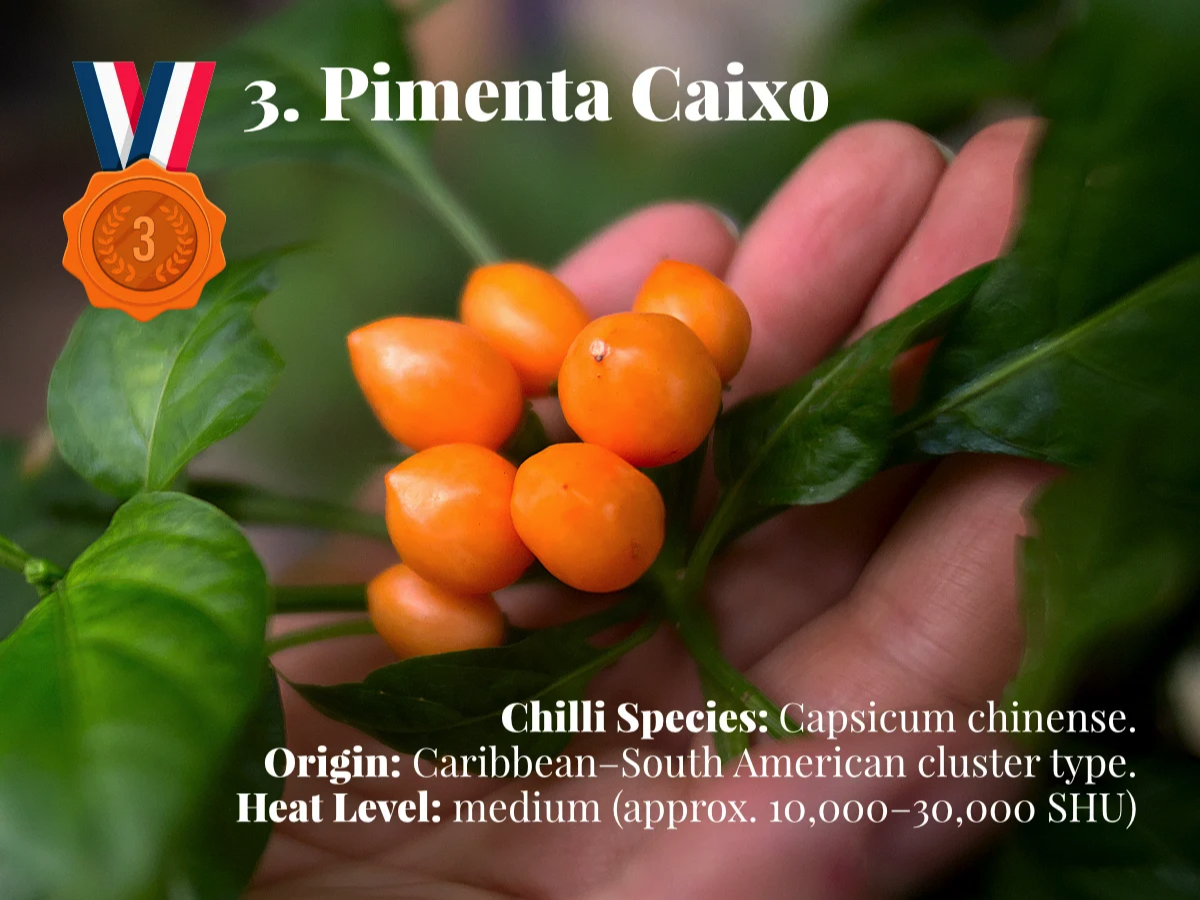
3. Pimenta CaixoSecond - Because it was the most amazing-looking of them all.
Every so often a plant turns up in the greenhouse that seems to be auditioning for another genus entirely; Pimenta Caixo looked less like a chilli and more like some whimsical ornamental, its apricot beads strung neatly along tall green spires. The plant grows with a confidence that borders on theatrical.
In the warmth of the greenhouse it shot upwards, producing necklaces of small spherical pods that shifted from lime green to a dusky peach as they ripened. Outdoors it was spirited through summer, then promptly surrendered when the cold arrived — understandable for a chilli with Caribbean–Amazonian ancestry, where “cool weather” is a concept rather than a season.
The flavour is remarkably charming: bright, fruity, lightly floral, not far from wiri wiri but gentler and rounder in temperament. Several of mine have already gone into a sweet brine, where their colour and shape make them look almost jewel-like. Put a bowl of them on the table and even people who claim not to like chillies suddenly get curious.
The plant’s unusual look turns out not to be ornamentation but botanical architecture. Some chinense types carry inflorescence genes that produce multiple flowers at a single node, each with very short stalks. When they all set fruit, you get these tight bead-like clusters — a reproductive strategy from humid regions where producing many flowers at once increases the odds of pollination.
Caixo makes the strategy look decorative. What I enjoy most is the plant’s sincerity: eccentric, unusual, and entirely happy to be itself. A quirky little chilli with real charm — and a beautiful one to pickle.
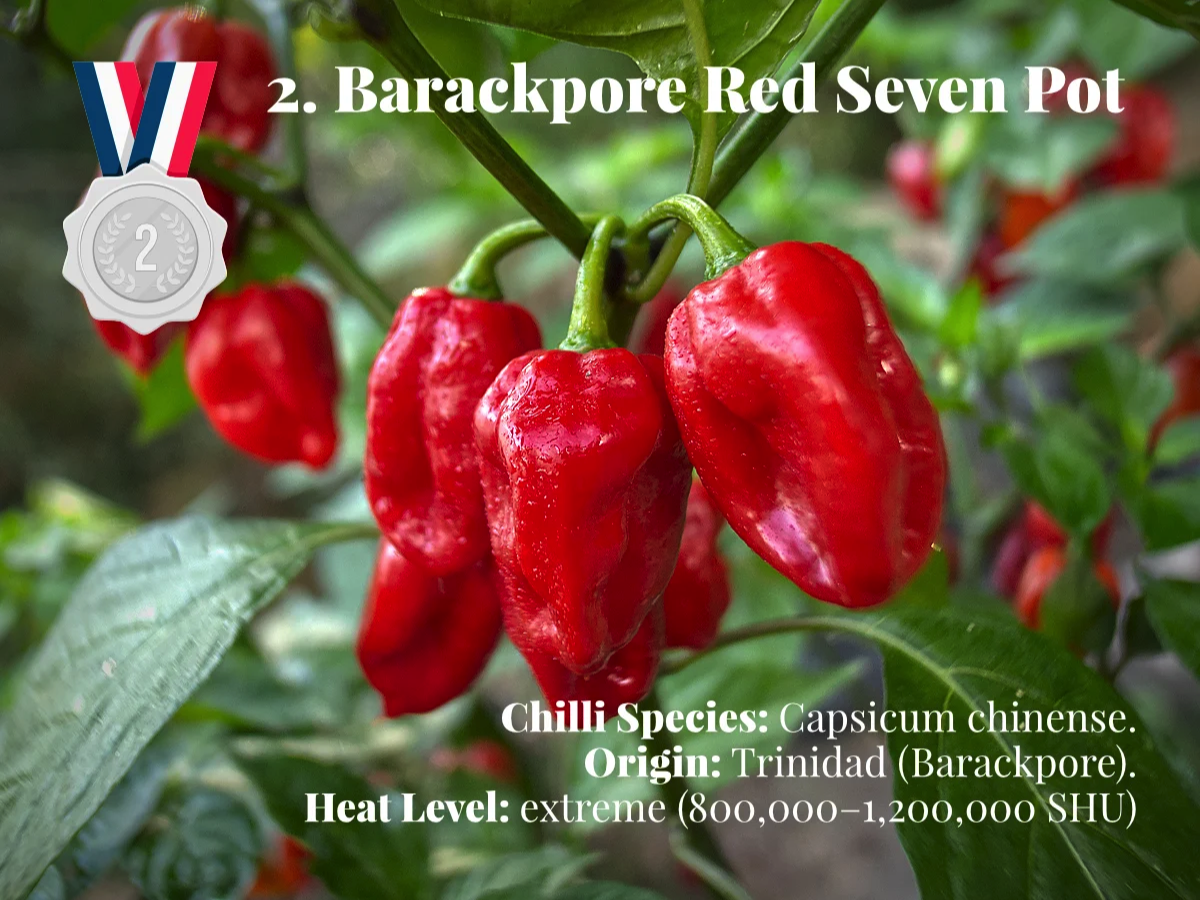
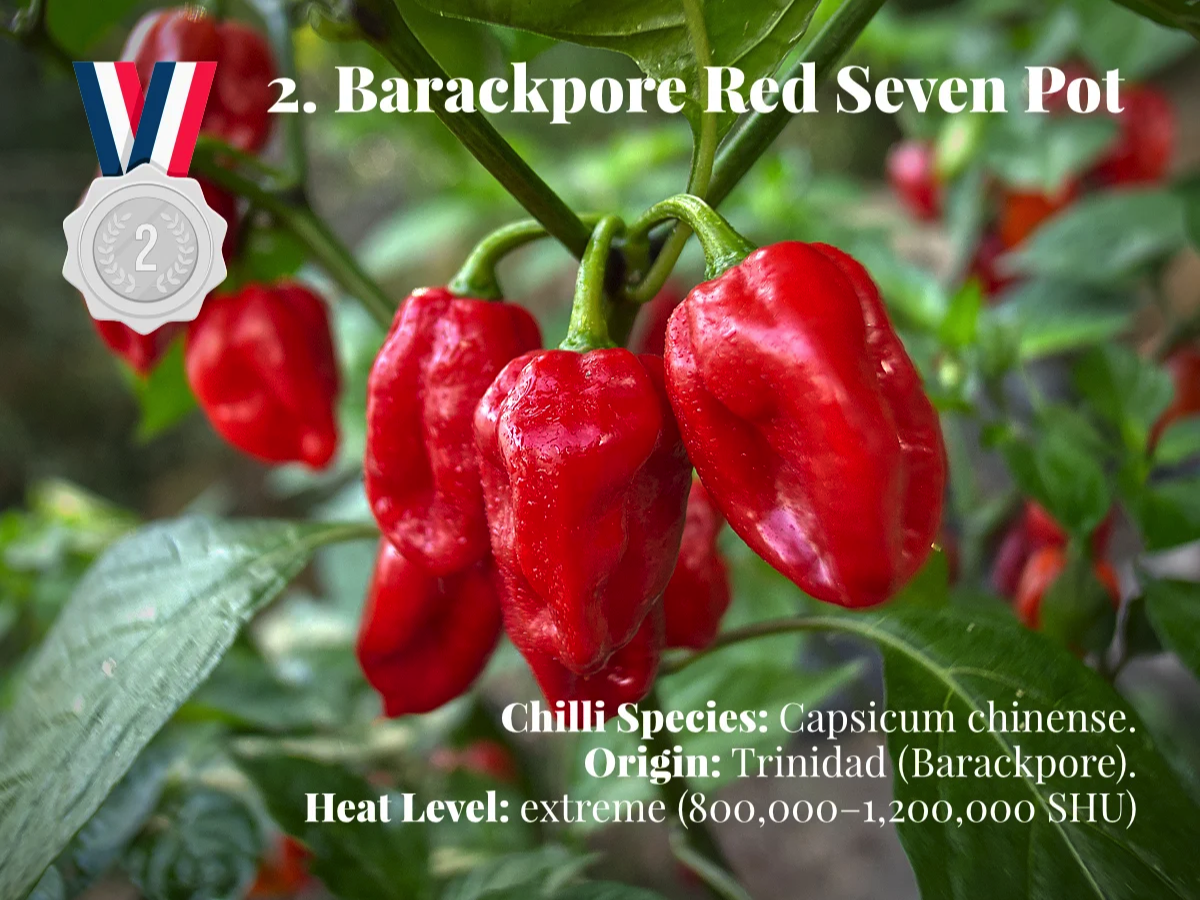
2. Barackpore Red 7 PotSecond - For behaving like a gentleman while quietly plotting arson.
You don’t expect menace from something knee-high, but the Barackpore spent the summer looking like a polite pot plant while quietly manufacturing enough fire to redraw the emotional landscape of anyone who got too close. In Trinidad, 7 Pot chillies aren’t just peppers — they’re part of the culinary grammar.
The name comes from the claim that a single pod can season seven pots of stew, but the truth sits deeper than folklore. In the Caribbean they’re used with purpose: to give pelau its backbone, to sharpen fish stews, to perfume callaloo, and — most importantly — to bring fruit, fire, and warmth to countless home-made hot sauces. Many cooks don’t chop 7 Pots; they dip one into a dish, swirl it like a paintbrush, then remove it.
My plant stayed compact — more a determined shrub than a bush — yet it produced pods with the same swagger as its island relatives. Thick, wrinkled, heavy-bodied fruit in a fierce lacquered red, each carrying that unmistakable chinense perfume: tropical fruit, faint smoke, and a heat that starts low and climbs like it’s got somewhere to be.
And while our British sunlight can’t coax out full Trinidadian ferocity, it gives something interesting instead: a cleaner, more elegant heat and a slightly sweeter undercurrent, perfect for sauces and ferments. Mine produced enough for pepper sauce, a few jars of chilli oil, and still left spares to frighten visitors.
What I admire most is how useful the Barackpore is — a super-hot that isn’t a stunt, but a chilli with real culinary backbone. A pantry item disguised as a dare.

1. Raging BullAnd first - My favourite — compact, cheerful, impossible not to resist.
I’d been told the Raging Bull was well behaved, which it was, in the same way a circus pony is well behaved: outwardly disciplined, but clearly plotting something exuberant the moment you turn your back. This modern hybrid draws on two very different traditions: the Brazilian Biquinho, famous for its sweet, pickled bar snacks, and the Habanero, whose floral esters and tropical lift define so much Caribbean heat.
The combination gives you a plant that stays tidy and compact while producing pods with far more personality than its size suggests. It’s one of those hybrids where you can almost feel the breeders aiming for reliability but also creating something with charm.
Through summer it delivered cluster after cluster of glossy, pint-sized chillies — bright, sweet, and lightly aromatic. The Biquinho side brings the fruitiness; the Habanero contributes that faint mango-like note that rises before the heat does.
The burn stays modest, more chatty than confrontational, which makes the Raging Bull a genuinely useful chilli: perfect for quick pickles, relishes, and anything that needs colour and lift without chaos. It’s also one of the first chillies people commented on when visiting the greenhouse — compact plants covered in fruit always make an impression.
There’s something endearing about a chilli that looks so composed while quietly preparing to out-produce half the greenhouse. The Raging Bull gets away with it because the results are delicious.
I hope you’ enjoy this little celebration of chillies as much as I’ve enjoyed growing them. If you’re already dreaming of next year’s heat, don’t forget: the 15% preorder discount ends on 31st December.
So, if you’re after plants or a good deal, it’s time to get your Santa skates on! And if you’re still short of a gift or two, don’t forget to check out the Offers—you might just find the perfect spicy surprise.
Finally, a very Happy Christmas from everyone at World of Chillies and thank you for all your support. Here’s to an even more bountiful harvest in 2026.
Alternatively, you can download a copy of the album here as a pdf
Share the joy
World of Chillies was set up by Sarah Hunt in 2011 to promote chilli growing and the enjoyment of everything hot and spicy.
Chilli Plants
Tomatoes
Chilli Seeds
Delivery Info
About Us
Contact Us
Sign Up Chilli Club
Privacy
Terms & Conditions